


Osteoarthritis (osteoarthritis deformans, popular name - salt deposition) is a chronic disease of the joints of a degenerative-dystrophic nature, in which the destruction of the articular cartilage, joint capsule and deformation of the bone itself occurs.
It should be noted that osteoarthritis is a whole group of joint diseases that have different origins and similar mechanisms of development.The most common osteoarthritis of large joints is:
- deforming osteoarthritis of the knee joint (gonarthrosis),
- deforming osteoarthritis of the hip joint (coxarthrosis),
- as well as osteoarthritis of the shoulder joint.
These are the most serious types of osteoarthritis.
Osteoarthritis of small joints is less common.Deforming osteoarthritis of the interphalangeal joints of the hands, as well as the metacarpophalangeal joints of the thumbs, are more common.Patients notice pain in the interphalangeal joints, a reduction in their mobility and the appearance of seals near the joints (Heberden's and Bouchard's ganglia).This type of osteoarthritis is more common in older people.Osteoarthritis of the joints of the foot is common.
Polyarthrosis, or generalized osteoarthritis, is characterized by damage to several joints at the same time.
Osteoarthritis joints of the spine - spondyloarthrosis - belong to the group of diseases of the spine, although they have a mechanism of development similar to other arthrosis.
The main clinical symptom of osteoarthritis is joint pain and decreased mobility.Specific symptoms are determined by the stage of osteoarthritis and depend on the degree of destructive changes in the joint.
Causes of osteoarthritis
Osteoarthritis It is customary to divide it into primary and secondary.Primary (idiopathic) osteoarthritis is a consequence of disruption of restorative processes and increased degeneration of the cartilaginous tissue of the joint without any deviations in the functioning of the whole organism.Secondary osteoarthritis occurs as a result of other pathological processes in the body or in a joint already damaged by external influence, with partial destruction of the joint surfaces.
Most often, traumatic osteoarthritis is diagnosed in young patients.And in older patients, it is not always possible to draw a clear line between primary and secondary osteoarthritis.
Although the exact cause of osteoarthritis cannot be determined, the factors contributing to its onset and development are well known.
The following types of reasons can be identified that contribute to the development of primary and secondary deforming osteoarthritis.
Causes of primary osteoarthritis - hereditary factors
The following hereditary disorders have been identified that can cause the development of primary osteoarthritis:
- genetic disorders in the composition of the cartilaginous tissue of the joint, leading to its accelerated destruction;
- congenital anomalies of the musculoskeletal system (hypermobility of joints, dysplasia, flat feet and others), which cause trauma to certain areas of the cartilaginous tissue of the joint and, as a result, the appearance of osteoarthritis.
It should also be noted that deforming osteoarthritis of the interphalangeal joints of the upper extremities occurs mainly in women and is inherited in the female line.
Causes of secondary osteoarthritis
Secondary osteoarthritis is a consequence of joint injury.This damage can be caused by various factors.
- Mechanical damage to joints.This group of factors includes various joint injuries, intra-articular bone fractures, as a result of which the structure of the joint is disrupted.The same result is caused by constant microtrauma of the joints resulting from constant excessive loads, both static and dynamic (for example in athletes).Obesity also leads to overload and joint injuries.
Another factor that negatively impacts the joints (mainly the hip joints) is poor posture.
The structure of the joint can also be disrupted by surgery. - Joint diseases.Osteoarthritis can be a consequence of inflammatory joint diseases (acute and chronic arthritis, synovitis, primary aseptic necrosis of bone tissue, etc.)
- Metabolic disorders, diseases of the endocrine system, mineral deficiency in the body.Various metabolic disorders, lack of calcium, phosphorus and other minerals, vitamins and microelements cause changes in the composition of bone and cartilage tissue, synovial fluid, which leads to disruption of recovery processes and gradual destruction of the composition.
- Autoimmune diseases(gout, chondrocalcinosis, hemochromatosis, psoriasis, rheumatoid arthritis), hormonal disorders, estrogen deficiency in postmenopausal women, lead to changes in joint tissues and their progressive destruction.
- Vascular diseases (atherosclerosis of the vessels of the lower extremities, obliterating endarteritis, varicose veins), as well as physical inactivity cause circulatory disorders in periarticular tissues, poor blood supply to joint tissues and, as a result, degenerative changes.
The mechanism of development of osteoarthritis
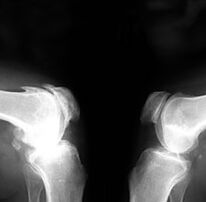
Development osteoarthritis begins with the destruction of cartilage.It is believed that initially there is a circulatory disorder in the capillaries of the subcartilaginous layer of the periosteum.Since the nutrition of cartilage is due to the supply of nutrients from intra-articular fluid and adjacent bone tissue, poor circulation leads to the fact that the cartilage gradually loses its elasticity, becomes thinner, cracks appear on it, the smoothness of the joint surfaces is disturbed, and the amount of synovial fluid that provides sliding in the joint decreases.Consequently, it appears pain and crunching when moving.The width of the joint space gradually decreases and bones form along the edges of the joint surfaces. osteophyte spines.
Ultimately, the joint becomes deformed and the range of motion decreases.This is how involutive osteoarthritis develops, associated with the aging of the body.The development of this form of osteoarthritis generally occurs gradually over several years.
Other forms of osteoarthritis of large joints, for example, post-traumatic, post-infectious, metabolic, intoxication, have slightly different mechanisms of development, but as a result we get similar changes in the joint.
Symptoms of joint osteoarthritis.Stages and degrees of osteoarthritis
The classification of osteoarthritis based on clinical and radiological signs is considered “classic”.In accordance with this, three stages of development of the disease are distinguished.It corresponds to a classification according to the degree of preservation of work capacity, distinguishing 3 degrees of osteoarthritis:
- I degree of osteoarthritis - the disease does not interfere with the performance of work, although it makes it difficult,
- II degree of osteoarthritis - the disease interferes with work performance,
- III degree of osteoarthritis - loss of working capacity.
Let's consider in more detail the clinical symptoms and signs of osteoarthritis at each of the indicated stages.
1st degree osteoarthritis (initial stage of osteoarthritis)
At the initial stage of the disease, in the morning, after rest, stiffness and difficulty in movement in the joints are observed, which gradually disappear some time after the start of movement.There may be some limitation of mobility at the joint.“Starting” pain (pain at the start of movement after a long period of rest) appears periodically.During sudden movements, the joint cracks, but there is no pain during movement.Pain at this stage of osteoarthritis appears only with significant and prolonged stress, and subsides after rest.At rest and with light effort, there is no pain.At this stage of the disease, patients rarely see a doctor.
On an x-ray with 1st degree osteoarthritis, no particular changes in the joint are visible;sometimes small osteophytes may be visible at the edges of the joint, the joint space is slightly narrowed.
Osteoarthritis 2 degrees (second stage of osteoarthritis)
With the further development of osteoarthritis, the pain becomes greater and becomes acute.A distinct cracking of the joint appears at any movement, there is a noticeable limitation of the mobility of the joint (contracture), functional shortening of the limb, disturbances in the biomechanics of movements, but the mobility of the joint is always preserved.At this stage, there is a noticeable increase in the initial pain, it becomes acute and lasts longer.Under the influence of daily physical activity, constant fatigue appears, a feeling of pressure in the affected joints and "mechanical pain" appear, caused by a decrease in the shock-absorbing capabilities of the cartilaginous tissues of the joint.
The destruction at the joint is already quite significant, the joints are already starting to partially deform.
X-rays show visible osteophytes, narrowing of the joint space 2-3 times compared to the norm, sclerosis of the subchondral bone and the formation of cystic cavities in the epiphyseal zone.
2nd degree osteoarthritis is characterized by a reduction in working capacity and the inability to perform certain types of work.
Osteoarthritis 3 degrees (third stage of osteoarthritis)
Osteoarthritis Stage 3 is a severe and advanced stage of the disease.At this stage, we observe the following elements:
- significant deformation of the joint (due to bone growth and accumulation of fluid in the joint cavity);
- abrupt restriction of movements, to the point of maintaining only swinging movements;
- sharp pain not only when moving, but also in a state of complete rest - constant pain associated with reflex spasms of neighboring muscles, as well as the development of reactive synovitis;
- joint inflammation,
- joint sensitivity to climatic changes.
- the muscles around the knee are spasmed and atrophied;
The axis of the limb is deformed, a varus or valgus curvature of the legs is noticeable (i.e. in the shape of the letter “O” or “X”).
On radiographs with grade 3 osteoarthritis, almost complete disappearance of the joint space, pronounced deformation of the articular surfaces and multiple extensive marginal osteophytes are observed.Articular mice and calcifications of paraarticular tissues can be detected.
By the 3rd year, the disease has progressed very far and is often already the cause of permanent disability.It looks like this:
- the pain becomes constant and painful: walking, and especially going up and down the stairs, is a difficult ordeal for the patient;
- a loud cracking noise during any movement, clearly audible to others;
- joint deformation is significant, movements are limited to a low amplitude, or even impossible;
Photographs show the destruction of intra-articular structures (ligaments and menisci), as well as complete abrasion of cartilage and signs of sclerosis (replacement of functional organs and structures with connective tissue).
Osteoarthritis 4 degrees
The state of complete destruction of the joint with osteoarthritisWhen the joint stops functioning completely, it is often classified as a separate 4th degree of osteoarthritis.There is a so-called "joint blockage" - an acute pain syndrome in which even limited movement of the affected joint is impossible.The fourth degree of osteoarthritis is accompanied by unbearable joint pain, which cannot be relieved even with strong painkillers and intensive physiotherapy.Complete ankylosis (fusion of the joint) or neoarthrosis (formation of a false joint between the displaced ends of the bones) is possible.In both cases, independent movement is almost impossible.
Photographs show gross sclerosis of the articular surfaces with pronounced cystic clearings, fusion of connecting bones at the joint space.The course of the disease at this stage almost always leads to disability, which can only be avoided by the implantation of an artificial joint prosthesis.
Treatment of osteoarthritis
Treatment of osteoarthritis at the initial stage of the disease
It is better to start treating osteoarthritis as early as possible, as soon as the first signs appear - cracking in the joints, difficulty in movement.At this stage, medications are useful - chondroprotectors that improve the structure of cartilage tissue, as well as vitamin and mineral complexes.
Physiotherapy, proper nutrition and preventive measures are important.It should be noted that prevention of osteoarthritis is of great importance in preventing exacerbation of the disease.
Treatment of osteoarthritis 2 to 3 degrees
Although it is no longer possible to completely cure osteoarthritis of grade 2-3, the process of its development can be significantly slowed down.Treatment of osteoarthritis at this stage includes the following stages:
- relieve or reduce pain
- relieve inflammation in the joint.
- improve the restoration of cartilage tissue and slow down degenerative processes.
In the acute period, treatment of osteoarthritis begins with pain relief.For this purpose, non-hormonal anti-inflammatory drugs (NSAIDs) and painkillers are used.Intra-articular injections of corticosteroids are possible.It is necessary to reduce the load on the joint;you should not walk or stand for long periods of time, or lift heavy objects.
After relieving acute pain syndrome, the main task is to ensure, as far as possible, the activation of restorative processes in the joint itself and in periarticular tissues: improvement of blood circulation, increase in metabolism, elimination of inflammatory processes.Chondroprotectors, vasodilators, as well as therapeutic exercises and physiotherapy are prescribed.
Treatment of 4th degree osteoarthritis
At this stage of the disease, the joint is almost completely destroyed.In this case, there is only one way out: surgery and replacement of the diseased joint with an endoprosthesis.The endoprosthesis significantly improves joint mobility and allows the patient to return to an active life, at least without pain.